Left-Leaning Red-Black Tree
Context: FIT2004_MOC · a 2-3 Tree drawn with ordinary binary BST nodes — a red edge glues two keys into one 3-node · sibling: AVL Tree Parent Framework: 2-3 Tree
Quick Revision
- 🎯 Objective: colour each edge (stored on its child) ➔ red edges cost no height ➔ equal black edges on every root-to-leaf path ⟹ the mirrored 2-3 tree is perfectly balanced ⟹ .
- 📦 Core Components: insert as a red leaf ➔ fix bottom-up with rotate left (red right link) · rotate right (two reds left-left) · colour flip (both children red) ➔ root to black.
- ⚡ Key Constraint: height here means black-height (black edges root ➔ leaf), not the drawn height; check every branch has the same black count after each insert. No delete in FIT2004.
📝 How It Works
1. Colours and Invariants
- Colour the connecting edge ➔ stored on the child of that edge; nodes are drawn coloured only for readability.
- No red parent with a red child ➔ two reds in a row would be a 4-node.
- Left-leaning ➔ a red link may only be a left child.
- Root is black ➔ at the end of every operation, a red root is recoloured black.
- Black-height ➔ number of black edges from root to leaf, equal on every path the 2-3 tree’s height (a lone root has black-height ). Red edges add none, which is what keeps it balanced.
2. Ian’s Way — 2-3 ⟷ LLRB
| 2-3 tree | LLRB |
|---|---|
| 2-node | black node |
| 3-node | black (the larger key, parent) with red left child |
| temporary 4-node | black with red and red |
| split, median promoted | colour flip |
| root split, height | red root recoloured black, black-height |
- Use it to verify ➔ convert your LLRB answer to a 2-3 tree (or vice versa) and check it matches the 2-3 insertion of the same keys.
3. Insert — Red Leaf, Then Fix Upward
- Descend as a BST, insert at a leaf, coloured red ➔ a red edge cannot change the black-height, so only the colour invariants can break.
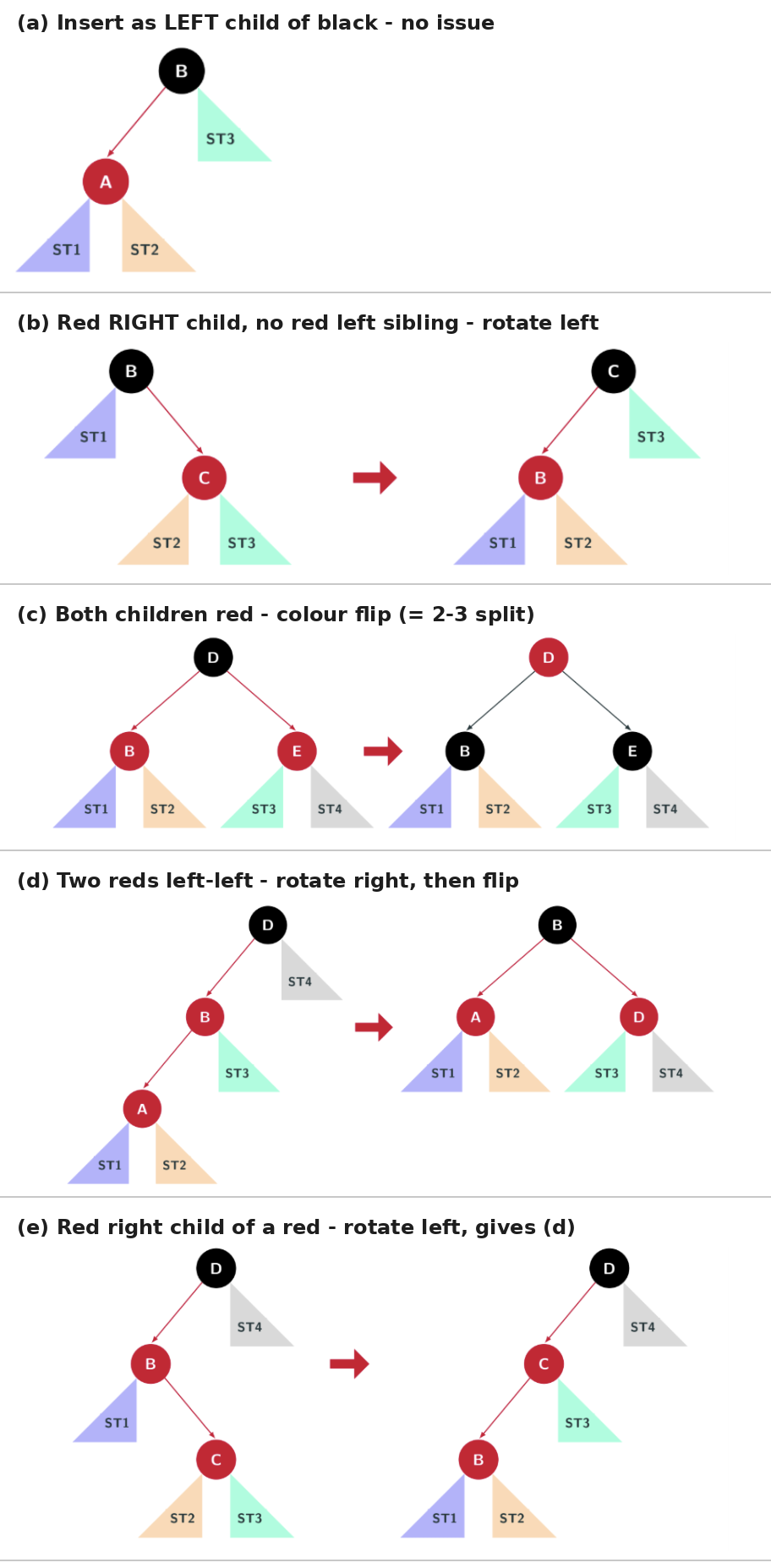
- Left child of a black node ➔ fine (a 2-node became a 3-node) — panel (a).
- Right child, left sibling not red ➔ rotate left: the right child becomes the parent and takes its colour, the old parent turns red — panel (b).
- Right child, left sibling red ➔ colour flip: parent red, both children black — panel (c).
- Left child of a red left child ➔ rotate right at the grandparent (Ian’s AVL trinode restructure: median on top, black, both others red), then flip — panel (d).
- Right child of a red left child ➔ rotate left at the red parent ⟹ panel (d) — panel (e). Ian’s restructure does (e)(d) in one step.
- Propagate ➔ a flip turns the parent red, which can create a new violation one level up; keep checking to the root, then recolour the root black.
⚖️ Complexity
(derived from the 2-3 correspondence)
| Operation | Time | Why |
|---|---|---|
| Search | plain BST search; drawn height black-height (no two reds in a row) | |
| Insert | descent rotations/flips per level on the way up | |
| Space | one colour bit per node |
📊 Exam Execution Trace & Applied Exercises
Manual Execution Trace — applied P6, inserts into an empty LLRB (r = red · bh = black-height)
| Step | Insert | Fix sequence | LLRB after | 2-3 mirror | bh |
|---|---|---|---|---|---|
| a | 40 | red root ⟹ black | 40 | [40] | |
| b | 20 | none — red left child | 40(20r,_) | [20 40] | |
| c | 5 | rotR@40 ➔ flip@20 ➔ root black | 20(5,40) | [20]([5],[40]) | |
| d | 1 | none | 20(5(1r,_),40) | [20]([1 5],[40]) | |
| e | 32 | none | 20(5(1r,_),40(32r,_)) | [20]([1 5],[32 40]) | |
| f | 64 | flip@40 ➔ rotL@20 | 40(20r(5(1r,_),32),64) | [20 40]([1 5],[32],[64]) | |
| g | 13 | flip@5 ➔ rotR@40 ➔ flip@20 ➔ root black | 20(5(1,13),40(32,64)) | [20]([5]([1],[13]),[40]([32],[64])) | |
| h | 5 | duplicate ⟹ unchanged | — | — | |
| i | 38 | rotL@32 | 20(5(1,13),40(38(32r,_),64)) | [20]([5]([1],[13]),[40]([32 38],[64])) | |
| j | 36 | rotL@32 ➔ rotR@38 ➔ flip@36 | 20(5(1,13),40(36r(32,38),64)) | [20]([5]([1],[13]),[36 40]([32],[38],[64])) |
- bh rises only at (c) and (g) ➔ the steps where a flip pushes red into the root and it is blackened — the 2-3 root split.
- Step (f) ➔ the flip at leaves it a red right child of ⟹ rotate left one level up; the 2-3 view is splitting into the root.
- Step (j) ➔ the flip leaves a red left child of black ⟹ legal, stop.
✍️ Practice
Practice 1: Convert the 2-3 tree
[25 50]([20],[30],[55 60])to an LLRB and state its black-height.
- Hint: Each 3-node becomes its larger key, black, with the smaller as a red left child.
Answer
- LLRB ➔
50(25r(20,30),60(55r,_)).- Black-height ➔ on every path (: red then black; : black then red) the 2-3 height.
- Why: One black edge per 2-3 level ➔ red edges only join keys inside a node.
Practice 2: Insert
1, 2, 3, 4, 5, 6, 7into an empty LLRB. List the fixes and the final tree.
- Hint: Ascending keys always land as a right child.
Answer
- Fixes ➔
2rotL@1 ·3flip@2, root black ·4rotL@3 ·5flip@4 then rotL@2 (the flip left as a red right child) ·6rotL@5 ·7flip@6, flip@4, root black.- Final ➔
4(2(1,3),6(5,7)), all black — the mirror of the 2-3 tree[4]([2]([1],[3]),[6]([5],[7])).- Why: A flip pushes red upward ➔ the parent can become a red right link, which needs its own rotate left one level up.
Practice 3 (prep P3): On
19(9(5r(4(1r,_),7),13),36(21r(20,35),37))insert , then , then .
- Hint: After each flip, look at the node that just turned red and its sibling.
Answer
- Insert 12 ➔ red left child of black ⟹ valid, no fix.
- Insert 8 ➔ red right child of black , no red left sibling ⟹ rotate left:
8(7r,_).- Insert 15 ➔ red right of beside red ⟹ flip@13 ( red) ⟹ now has red and red ⟹ flip@9 ⟹ is a red left child of black ⟹ valid, stop.
- Final ➔
19(9r(5(4(1r,_),8(7r,_)),13(12,15)),36(21r(20,35),37)), black-height on every path.- Why: 2-3 mirror ➔ makes , promoted makes , promoted makes root — two splits, two flips, no root split so the root stays black.
Practice 4 (applied P5b): Convert
[15]([6]([3]([0],[4 5]),[10]([8],[12])),[51]([19 25]([16 18],[23],[28]),[65]([60 62],[70])))to an LLRB.
- Hint: Work node by node; a 3-node’s left and middle children hang under the red key, its right child under the black key.
Answer
- LLRB ➔
15(6(3(0,5(4r,_)),10(8,12)),51(25(19r(18(16r,_),23),28),65(62(60r,_),70))).- Check ➔ black-height on every path (: black, black, red, black, red) the 2-3 height.
- Why: ➔ black , red left ; takes and , keeps on its right.
⚠️ Common Mistakes
- 💡 Measuring height by drawn levels ➔ count black edges only; the drawn tree may be up to twice as tall.
- 💡 Forgetting the final root recolour ➔ after a flip at the root it is red; set it black (black-height ).
- 💡 Putting the red key on the right of a 3-node ➔ left-leaning: the smaller key is the red left child.
🧠 Active Recall
Why is a newly inserted node always red?
Answer
- Short answer: a red edge adds no black-height, so the balance invariant cannot break — only colour rules can, and those are fixed locally.
- Why: 2-3 view ➔ inserting red means adding the key into an existing node (2 ➔ 3 or 3 ➔ 4-node) rather than creating a new level; a black insert would lengthen one path and break perfect black balance.
Why is inserting as the right child of a black node a problem, but not as the left child?
Answer
- Short answer: a red right link violates left-leaning; it is still a valid 3-node, just drawn the wrong way.
- Why: One encoding per 3-node ➔ rotate left swaps parent and child so the smaller key becomes the red left child, restoring the unique 2-3 ⟷ LLRB mapping.