Multivariate Normal Distribution
Context: FIT2086_MOC · W11 · the Gaussian Distribution in dimensions with correlation between attributes · entries are the covariances · the class model inside Mixture Models (EM Algorithm) · the correlation engine of multivariate-normal imputation
Quick Revision
- 🎯 Objective: ➔ is the mean of , ➔ read a scatter’s centre, spread per axis, and tilt straight off and .
- ⚡ Key Constraint: diagonal entries are variances, not standard deviations (); off-diagonals are covariances and is symmetric.
📝 Core
- Density ➔ .
- Reduces to the univariate normal ➔ , : ⟹ .
- Why it matters ➔ an individual’s attributes are related (height ↔ weight); separate univariate models per attribute cannot express that, can.
- Covariance structures ➔ diagonal, all variances equal (spherical, variance parameter) · diagonal, variances differ () · arbitrary (elliptical, ) ➔ each more flexible but with more parameters to estimate.
- Quadratic form = distance ➔ is the Mahalanobis-type distance a Gaussian mixture uses in place of Euclidean.
📊 Reading from a scatter
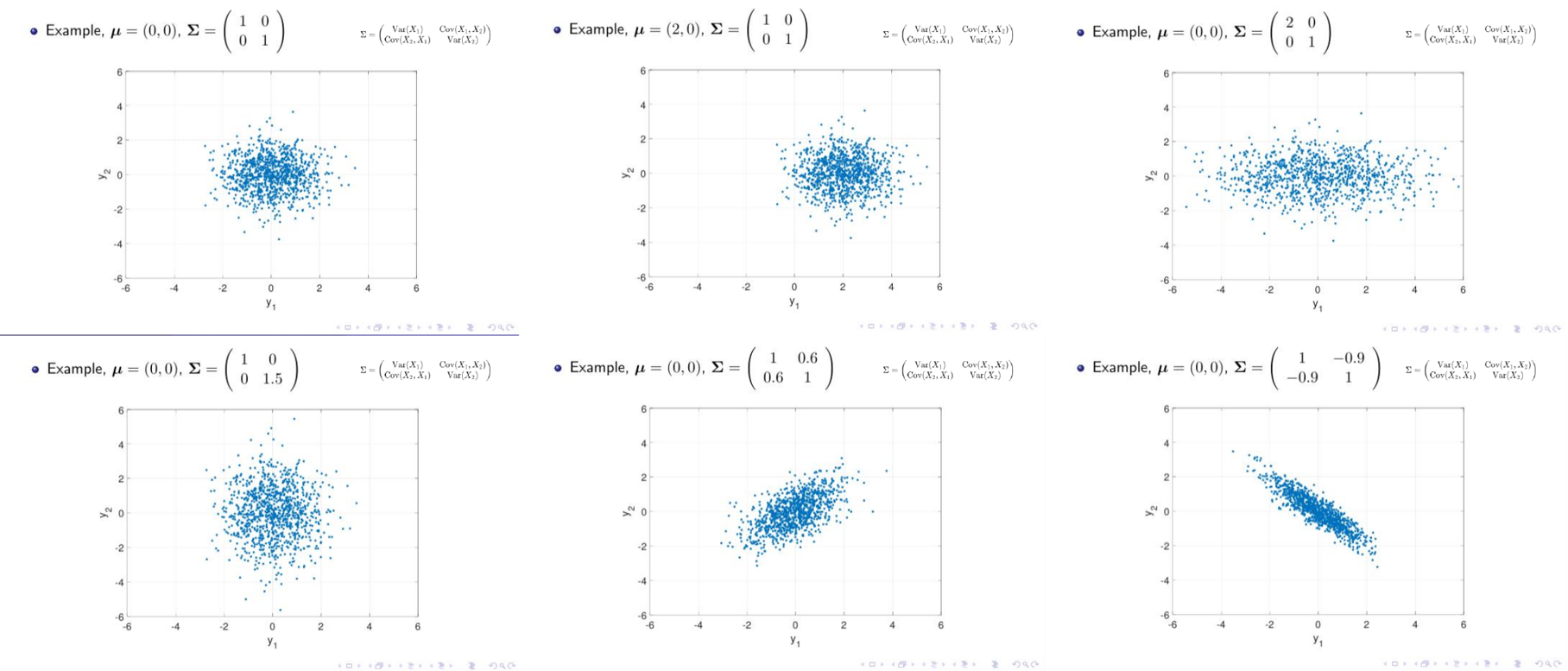
| Cloud shape | ||
|---|---|---|
| circle at the origin | ||
| same circle shifted right — moves, shape fixed | ||
| stretched along | ||
| stretched along | ||
| ellipse tilted up-right (positive covariance) | ||
| thin ellipse tilted down-right (strong negative) |
⚠️ Common Mistakes
- 💡 Reading as an sd ➔ it is ; R’s
rnormwants the sd, holds variances. - 💡 Zero off-diagonals read as “no structure” ➔ only the tilt disappears; unequal diagonals still stretch the cloud along an axis.
🧠 Active Recall
When does a mixture of multivariate normals beat one with independent univariate normals per attribute, and what does it cost?
Answer
- Short answer: when attributes are correlated within a class (tilted clusters); an arbitrary captures the tilt but costs covariance parameters per class instead of .
- Why: Flexibility vs complexity ➔ the extra parameters must pay for themselves in fit under the information criterion.