Primary Key
Context: FIT2094_MOC · the chosen candidate key identifying a relation · selected by desirable-key criteria · natural vs surrogate
Quick Revision
- 🎯 Objective: the one candidate key chosen as the relation’s identifier ➔ underlined in schema notation.
- 📦 Core Components: desirable-key criteria ➔ natural vs surrogate PK.
- ⚡ Key Constraint: carry the natural key through the whole design; add a surrogate only at the last step.
📝 Core
1. The Primary Key
- Definition ➔ the one candidate key chosen as identifier; the rest become alternate keys.
- Notation ➔ underlined, e.g. .
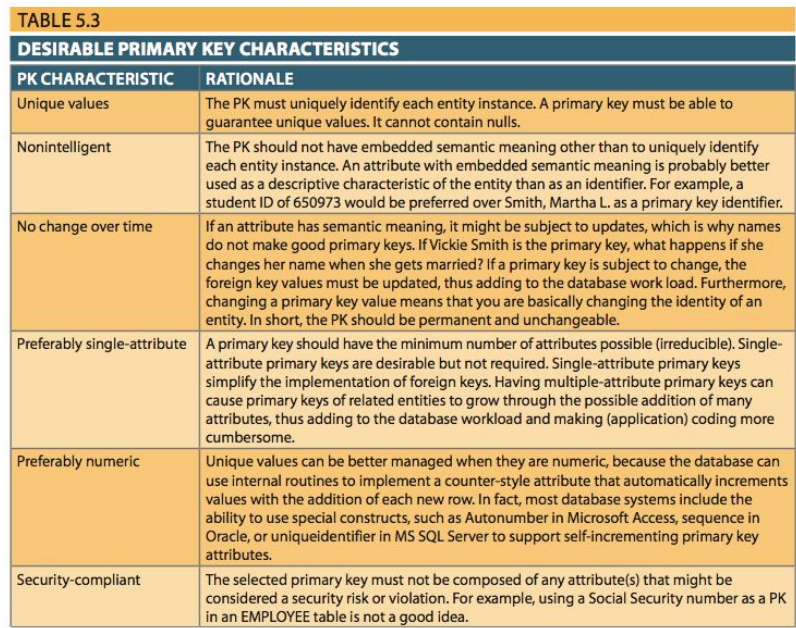
2. Desirable Characteristics
- Unique + non-NULL ➔ entity integrity.
- Non-intelligent + stable ➔ no embedded meaning, no change over time.
- Preferably single-attribute + numeric ➔ simple FKs, auto-increment.
- Security-compliant ➔ never a sensitive value (no TFN/SSN).
3. Natural vs Surrogate
- Natural ➔ from the scenario (super→candidate→PK), captures business rules.
- Surrogate ➔ artificial meaningless id (
enrolment_id), added by the designer.
Key identities:
⚖️ Core Decision Matrix
| Criterion | Good PK | Bad PK (name) |
|---|---|---|
| unique | yes | no (shared names) |
| non-intelligent | yes | no (meaningful) |
| stable | yes | no (changes on marriage) |
| single/numeric | yes | no |
When It Flips: composite natural keys are valid but bloat FKs in children — the motivation for a single numeric surrogate. The PK functionally determines all attributes (Functional Dependency); it must reflect future data, not just current rows.
📊 Exam Execution Trace
Manual Execution Trace
Testing name as PK:
| Step / State | Criterion | Name passes? |
|---|---|---|
| 0 (Init) | — | — |
| 1 | unique | no |
| 2 | stable | no (marriage) |
| 3 | non-intelligent | no |
⚠️ Common Mistakes
- 💡 Carry the natural key through the design ➔ it encodes the business rules; a surrogate is added only at the final step (and is banned at the conceptual stage).
🧠 Active Recall
List the desirable characteristics of a primary key and why a name is poor.
- Hint: Unique/stable/non-intelligent.
Answer
- Short answer: Unique, non-NULL, non-intelligent, stable, preferably single/numeric, security-compliant; a name fails uniqueness, stability, non-intelligence.
- Why: PK change cascades ➔ altering a PK changes identity and forces FK updates.
Contrast a natural and a surrogate primary key, and when each is introduced.
- Hint: Rules vs convenience.
Answer
- Short answer: Natural = from scenario (captures rules); surrogate = artificial id; natural carried through, surrogate added at the last step.
- Why: Banned conceptually ➔ surrogate replaces an unwieldy composite only at logical/physical design.