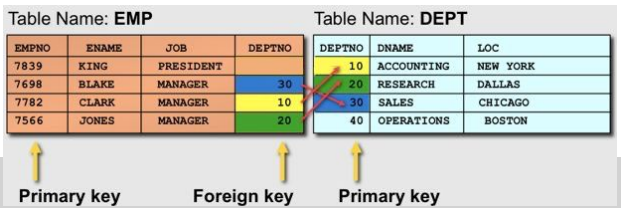
Context:FIT2094_MOC · an FK is a Primary Key appearing in another relation · must match a full PK or be NULL · how relationships are implemented relationally
Quick Revision
🎯 Objective: a PK appearing in another relation ➔ every FK matches a full PK or is NULL.
📦 Core Components: FK ➔ referential integrity ➔ implements relationships.
⚡ Key Constraint: must match the full PK (composite too) or be NULL; NULL FK = optional participation.
📝 Core
1. The Foreign Key
Definition ➔ an attribute set that exists as a Primary Key in the same or another relation.
ALTER TABLE emp ADD CONSTRAINT dept_emp_fk
    FOREIGN KEY (deptno) REFERENCES dept (deptno) ON DELETE SET NULL;
💡 Common Mistake:Match the full PK or be NULL ➔ the president has NULL deptno (no department, allowed); a partial match on a composite PK is invalid.
⚖️ Core Decision Matrix
FK state
Valid?
Meaning
equals a full PK
✅
related parent exists
NULL
✅
optional participation
partial composite match
❌
violates referential integrity
dangling (no PK)
❌
rejected by RDBMS
When It Flips: a conceptual relationship becomes a concrete FK column (Conceptual vs Logical Model); a NULL FK is the circle (min 0) of Crow's Foot. Deletes of a referenced PK are restricted or cascaded.
📊 Exam Execution Trace
Manual Execution Trace
Validating EMP.deptno:
Step / State
EMP.deptno
Valid?
0 (Init)
—
—
1
10 (exists in DEPT)
✅
2
NULL (president)
✅
3
99 (no such DEPT)
❌
Applied Exercise
Problem: Can EMP.deptno be NULL? Can it be a department not in DEPT?
Derivation Proof / Hand-Calculation Walkthrough:
Final Extracted Output: NULL allowed; an unmatched value is rejected.
🧠 Active Recall
Define a foreign key and state the referential integrity rule.
Hint: PK in another relation.
Answer
Short answer: An FK is a PK appearing elsewhere; every FK value matches a full PK or is NULL.
Why:PK–FK links ➔ EMP.deptno must be an existing DEPT.deptno or NULL.
Why is a NULL FK permitted, and what must an FK referencing a composite PK do?
Hint: Optional participation + full match.
Answer
Short answer: NULL FK = optional participation (min 0); a composite-PK FK must match entirely.
Why:Two valid states ➔ equals a complete existing PK, or NULL.
CUST_TRAIN.cust_id references CUSTOMER. Which on-delete rule, and why not CASCADE or SET NULL?
Hint: Mandatory participation ⟹ RESTRICT.
Answer
Short answer: RESTRICT — a training record must always name a valid customer, so a customer referenced in CUST_TRAIN cannot be deleted.
Why:Participation reading ➔ SET NULL would orphan the record (which customer?); CASCADE would erase historical training records; RESTRICT preserves both.