Conceptual vs Logical Model
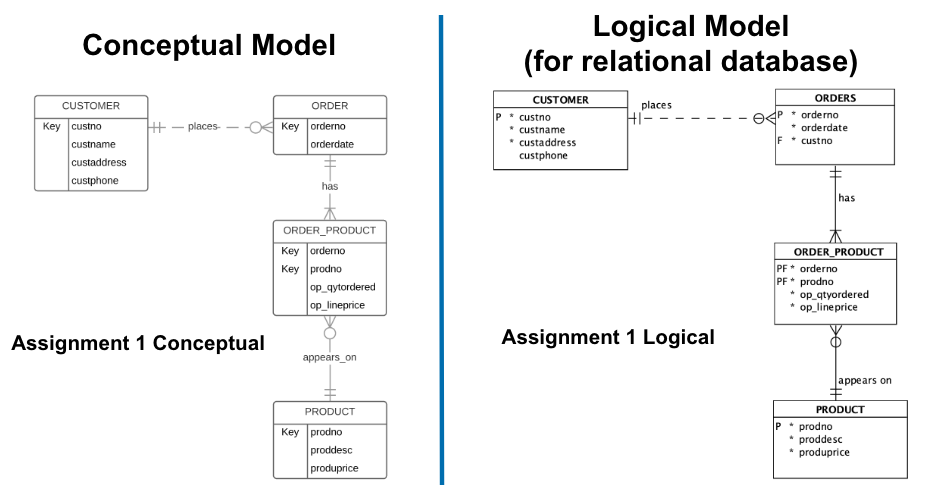
Context: FIT2094_MOC · maps a Conceptual Model to a relational schema · entity → relation, with Primary and Foreign keys · M:N must be resolved
Quick Revision
- 🎯 Objective: refine a conceptual model for a chosen DB type (relational) ➔ entity → relation, relationship → FK.
- 📦 Core Components: entity → relation ➔ key attr → PK | relationship → FK.
- ⚡ Key Constraint: M:N cannot exist relationally — resolve into two 1:M via a bridge.
📝 Core
1. The Mapping
- Entity → relation ➔ each entity becomes a table.
- Key attr → Primary Key ➔ marked
P, underlined. - Relationship → Foreign Key ➔ parent’s PK copied into child, marked
F/starred.
2. Resolving M:N
- Cannot implement ➔ relational DBs have no M:N construct.
- Two 1:M ➔ insert a bridging Associative Entity with composite PK + two FKs.
3. Detail Level
- Conceptual ➔ high-level meaning; logical ➔ implementation-ready, one DB type (still vendor-free).
- Reserved words ➔ rename clashes (
ORDER→ORDERS).
Key identities:
When It Flips: a relationship (an association conceptually) becomes a concrete column (the FK, the parent's PK in the child) logically. Surrogate keys, banned conceptually, may be introduced from the logical model onward. The relations produced are n-ary relations.
📊 Exam Execution Trace
Manual Execution Trace
Mapping CUSTOMER places ORDER (M:N ORDER–PRODUCT):
| Step / State | Conceptual | Logical |
|---|---|---|
| 0 (Init) | — | — |
| 1 | CUSTOMER entity | CUSTOMER relation, PK custno |
| 2 | places | ORDERS.custno FK |
| 3 | ORDER–PRODUCT M:N | ORDER_PRODUCT bridge |
⚠️ Common Mistakes
- 💡 M:N must be resolved logically even without attributes ➔ a relational DB can’t implement M:N, so ORDER–PRODUCT becomes a composite-PK bridge with two FKs.
🧠 Active Recall
How are entities, keys, and relationships mapped to a relational logical model?
- Hint: Relation / PK / FK.
Answer
- Short answer: Entity → relation; key attr → Primary Key; relationship → Foreign Key (parent PK in child).
- Why: Schema ➔ .
Why must a many-to-many relationship be resolved logically, and how?
- Hint: No relational M:N.
Answer
- Short answer: Convert to two 1:M via a bridge whose PK is the composite of both parents’ keys + an FK to each.
- Why: Kept conceptually ➔ M:N is simpler on the conceptual model, resolved only for the relational target.