Associative Entity
Context: FIT2094_MOC · resolves a many-to-many relationship · a bridging entity with a composite key · the only way Crow’s Foot stores relationship attributes
Quick Revision
- 🎯 Objective: bridge two entities in an M:N ➔ split into two 1:M, carrying the association’s attributes.
- 📦 Core Components: composite key (both parents’ keys) ➔ two identifying relationships.
- ⚡ Key Constraint: the only way Crow’s Foot stores relationship attributes.
📝 Core
1. The Bridge
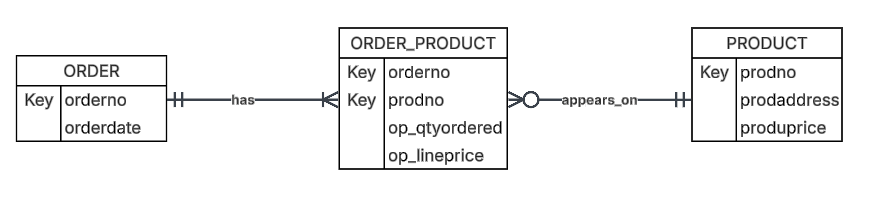
- Definition ➔ an entity between two entities in an M:N relationship, turning it into two 1:M.
- Key ➔ composite of the two parents’ keys.
- Holds ➔ any attributes belonging to the M:N association.
2. Why It Exists
- Crow’s Foot limit ➔ can’t attach attributes to a relationship line.
- Break the M:N ➔ insert a middle entity (
ORDER_PRODUCT). - Weak entity ➔ joins both parents by two identifying relationships.
3. When to Add
- Conceptual ➔ keep M:N; add a bridge only when attributes to record.
- Logical ➔ every M:N resolved (relational DBs can’t implement M:N).
⚙️ Core Implementation
🔹 ORDER–PRODUCT bridge
Mermaid + schema
erDiagram ORDER ||--|{ ORDER_PRODUCT : has PRODUCT ||--o{ ORDER_PRODUCT : appears_on💡 Common Mistake: Composite key needs both parents ➔ to find one line’s
op_qtyorderedyou need both orderno and prodno (e.g. order 61384, product M128).
⚖️ Core Decision Matrix
| Stage | M:N handling | Trigger |
|---|---|---|
| conceptual | kept as M:N | simpler/desirable |
| conceptual + attrs | add bridge | attributes to store |
| logical (relational) | always resolve | no relational M:N |
| key | composite PK + 2 FKs | both parents |
When It Flips: the bridging entity inherits both parents' keys, so it joins them by two identifying relationships and is itself a weak entity. A bridge table is an n-ary Relation over the parents' keys.
📊 Exam Execution Trace
Manual Execution Trace
STUDENT enrols UNIT (with enrolment attributes):
| Step / State | Element | Result |
|---|---|---|
| 0 (Init) | — | — |
| 1 | STUDENT M:N UNIT | needs bridge |
| 2 | attributes | enrol_year, mark, grade |
| 3 | bridge | ENROLMENT (composite key) |
Applied Exercise
Problem: Resolve STUDENT M:N UNIT carrying enrol_mark, enrol_grade.
Derivation Proof / Hand-Calculation Walkthrough:
Final Extracted Output: two 1:M (STUDENT makes ENROLMENT, UNIT has ENROLMENT); composite key holds the attributes.
🧠 Active Recall
What problem does an associative entity solve, and how is its key formed?
- Hint: Attributes on an M:N.
Answer
- Short answer: Crow’s Foot can’t put attributes on a line, so a bridge splits the M:N into two 1:M; its key is the composite of both parents’ keys.
- Why: Both keys needed ➔ e.g. to retrieve a line.
When should an associative entity be introduced — conceptually vs logically?
- Hint: Attributes vs relational limit.
Answer
- Short answer: Conceptually only when attributes exist; logically always (relational DBs can’t do M:N).
- Why: Composite PK + two FKs ➔ the bridge becomes a relation on both parents.