Relationship (Conceptual Modelling)
Context: FIT2094_MOC · a logical association between entities · classified by degree (unary/binary/ternary) · labelled with a verb
Quick Revision
- 🎯 Objective: a logical association between entities ➔ the only way entities connect on a conceptual model.
- 📦 Core Components: degree unary/binary/ternary ➔ verb label ➔ min/max cardinalities.
- ⚡ Key Constraint: ternary resolved by a composite entity; two entities may share multiple distinct relationships.
📝 Core
1. The Relationship
- Definition ➔ a logical association (“a customer places many orders”).
- Only connector ➔ the sole way entities connect on a Conceptual Model.
- Degree ➔ number of entities involved.
2. Degree
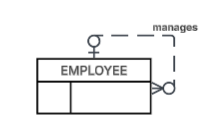
- Unary (recursive) ➔ entity with itself (
EMPLOYEEmanagesEMPLOYEE). - Binary ➔ two entities (most common;
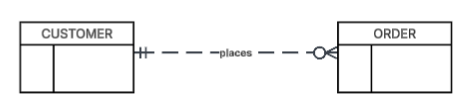
CUSTOMERplacesORDER). - Ternary+ ➔ >2 entities ➔ resolved by a composite entity (
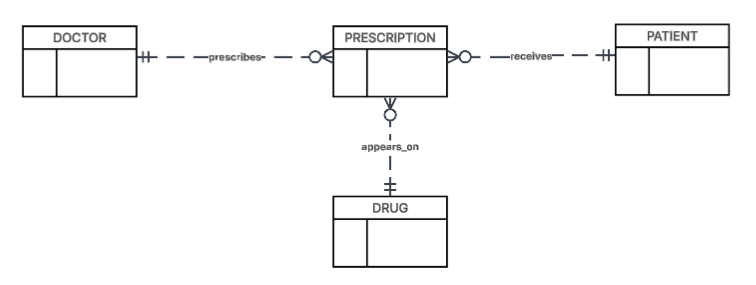
PRESCRIPTION).
3. Multiplicity of Relationships
- Multiple links ➔ two entities can share more than one relationship, modelled separately.
- Example ➔ EMPLOYEE member of TEAM and leader of TEAM = two lines.
- Label direction ➔ name in the 1:M direction (
places,has).
⚙️ Core Implementation
🔹 Binary relationship
Mermaid erDiagram
erDiagram
  CUSTOMER ||--o{ ORDER : places
💡 Common Mistake: Model only the brief’s relationships ➔ a derivable/redundant association (already implied by existing relationships) must not be added; the brief decides, not intuition.
⚖️ Core Decision Matrix
| Degree | Entities | Resolution |
|---|---|---|
| unary | 1 (recursive) | self-referencing FK |
| binary | 2 | direct line |
| ternary+ | ≥3 | composite entity |
| M:N binary | 2 | Associative Entity (if attributes) |
When It Flips: M:N is kept on the conceptual model (simpler/desirable) and resolved into an Associative Entity only when attributes must be stored or at the logical stage. A relationship here is the ER counterpart of a Binary Relation.
📊 Exam Execution Trace
Manual Execution Trace
Classifying by degree:
| Step / State | Relationship | Degree | Note |
|---|---|---|---|
| 0 (Init) | — | — | — |
| 1 | EMPLOYEE manages EMPLOYEE | unary | recursive |
| 2 | CUSTOMER places ORDER | binary | common |
| 3 | doctor–drug–patient | ternary | → PRESCRIPTION |
Applied Exercise
Problem: EMPLOYEE is a member and a leader of a TEAM. Model it; may a derivable relationship be added? Derivation Proof / Hand-Calculation Walkthrough:
Final Extracted Output: two labelled relationships; no redundant/derivable relationship added.
🧠 Active Recall
Define relationship degree and give unary/binary/ternary examples.
- Hint: Entity count.
Answer
- Short answer: Degree = entities involved; unary (EMPLOYEE manages EMPLOYEE), binary (CUSTOMER places ORDER), ternary (doctor–drug–patient).
- Why: Ternary resolution ➔ add a composite entity (
PRESCRIPTION).
If two entities have two real-world associations, how are they modelled, and may you add a relationship not in the brief?
- Hint: Separate lines; brief-only.
Answer
- Short answer: Two separate relationships; distinct associations can’t merge; no unstated relationship added.
- Why: Exactly the brief ➔ even a derivable/redundant relationship is excluded.